For a new clothing brand, finding a factory is only the first step. What truly determines whether your samples turn out well, whether pricing is accurate, and whether bulk production runs smoothly is the quality of communication between your brand and the factory.
Many first-time clients often ask:
“How much does this garment cost?”
“What is the minimum order quantity?”
“Can you produce this based on this picture?”
However, with only a reference image, factories cannot accurately determine fabric, fit, construction, or production complexity, and therefore cannot provide a reliable bulk price.
Professional garment development is not about copying an image—it is about transforming design ideas into production-ready standards.
Step 1: Clearly Define Your Brand Positioning and Market
Before starting sampling, please provide the factory with:
• Target country or region
• Target customer group
• Retail price range
• Brand quality positioning
• Estimated initial order quantity
This information is not used to judge your brand size, but to help select the right materials, techniques, and production approach.
For example, a T-shirt retailing at $30 versus $100 will differ significantly in fabric, fit, washing process, stitching, and packaging.
The clearer your positioning, the more accurate the factory’s proposal will be.
Step 2: Provide Complete Style Information
If you already have a Tech Pack, share it directly with the factory.
If not, you can prepare:
• Front, back, and detail reference images
• Fabric composition, weight, or hand feel requirements
• Color and size range
• Printing, embroidery, washing, or special techniques
• Labels, tags, and packaging requirements
• Reference measurements or existing samples
Reference images help communicate design direction, but they cannot replace complete production data.
For example, an image cannot accurately show garment length, chest width, fabric elasticity, internal structure, or stitching methods. The more complete your information, the closer the first sample will be to your expectations, reducing revisions, time, and cost.
Step 3: Share Your Estimated Order Quantity
Many clients hesitate to provide estimated quantities during sampling, but quantity directly affects fabric sourcing, production methods, and pricing.
Producing 50, 300, or 1000 pieces involves completely different approaches.
Quantity impacts:
• Whether fabric can be custom-made
• Whether supplier minimums can be met
• Printing, embroidery, and trim costs
• Cutting and production planning
• Unit price
Knowing your estimated quantity allows the factory to evaluate production feasibility early and avoid issues such as unavailable fabrics, high minimums, or unexpected costs.
Your estimate does not need to be exact—just provide a reasonable range, such as 50–100 pieces, around 300 pieces, or 1000+ pieces.
Step 4: Confirm Sampling Plan and Costs
After reviewing your information, the factory will analyze:
• Fabric and trim availability
• Pattern structure feasibility
• Production suitability
• Potential quality risks
• Sample cost and timeline
A professional factory will raise concerns before sampling if certain design elements may affect wearability, production stability, or cost.
Once both sides confirm fabric, measurements, techniques, sample cost, and timeline, the factory will proceed with pattern making and sample production.
Step 5: Provide Clear and Consolidated Feedback
After receiving the sample, avoid vague feedback like “something feels off.”
Instead, provide specific instructions such as:
• Increase garment length by 2 cm
• Reduce sleeve opening by 1 cm
• Fabric needs better drape
• Neckline should fit closer
• Move embroidery up by 1.5 cm
• Keep waist the same, increase hip by 2 cm
It is best to compile all feedback into one document and mark changes directly on images.
Clear and organized feedback prevents conflicting instructions and helps pattern makers make accurate adjustments.
Step 6: Confirm Pre-Production Sample Before Bulk Order
Once the sample is approved, the factory will calculate the final bulk price based on confirmed specifications.
Before placing an order, both parties should confirm:
• Final size chart
• Fabric and colors
• Printing, embroidery, and other techniques
• Labels and packaging
• Quantity per size and color
• Delivery timeline
• Quality standards
• Payment terms
Any changes in fabric, sizing, techniques, or quantity may affect pricing.
Confirming all details before production minimizes misunderstandings, cost changes, and quality disputes.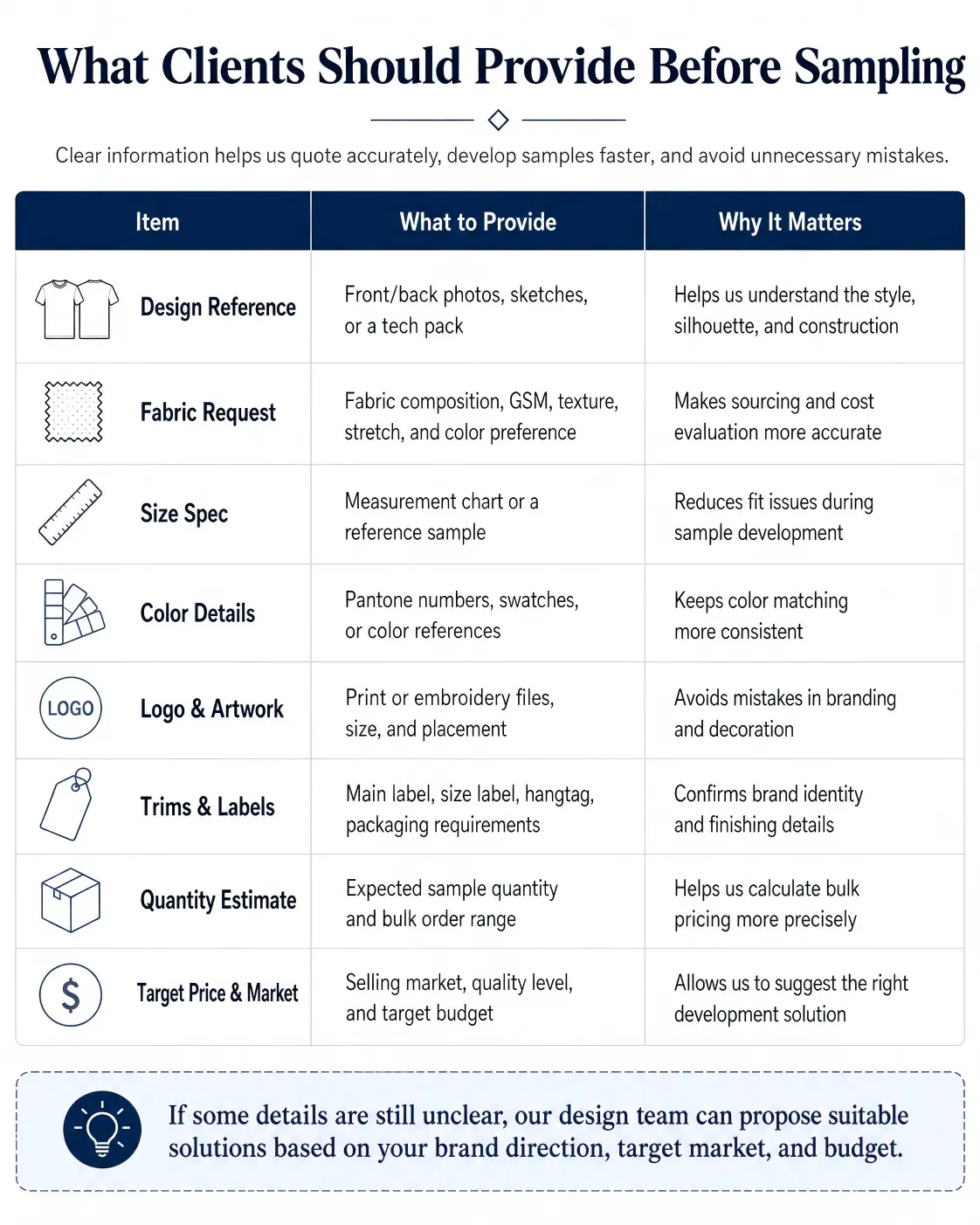
Why We Emphasize Pre-Sampling Communication
Most production issues do not occur during sewing—they originate in the early development stage.
Incomplete information, unclear quantities, misunderstandings about materials, or vague feedback can lead to:
• Multiple sample revisions
• Extended development timelines
• Budget overruns
• Sample fabrics unsuitable for bulk production
• Inconsistency between samples and bulk goods
• Delayed delivery
A professional factory does not rush to offer the lowest price—it first ensures a clear understanding of product requirements and then provides a practical production solution.
Good Collaboration Starts with Clear Communication
Working with a Chinese garment factory for the first time does not require you to know everything about apparel production.
Your role is to clearly communicate your product direction, budget, estimated quantity, and quality expectations. The factory’s role is to translate these into materials, patterns, techniques, and production standards.
At Odian Apparel, we don’t just make samples—we identify potential issues early, manage risks, and ensure that your samples are ready for scalable production.
Learn more about how we support new brands at:
https://odianapparel.com/
When both sides communicate clearly, sampling becomes faster, pricing becomes more accurate, and bulk production becomes more stable.
This is the foundation of a long-term partnership.

